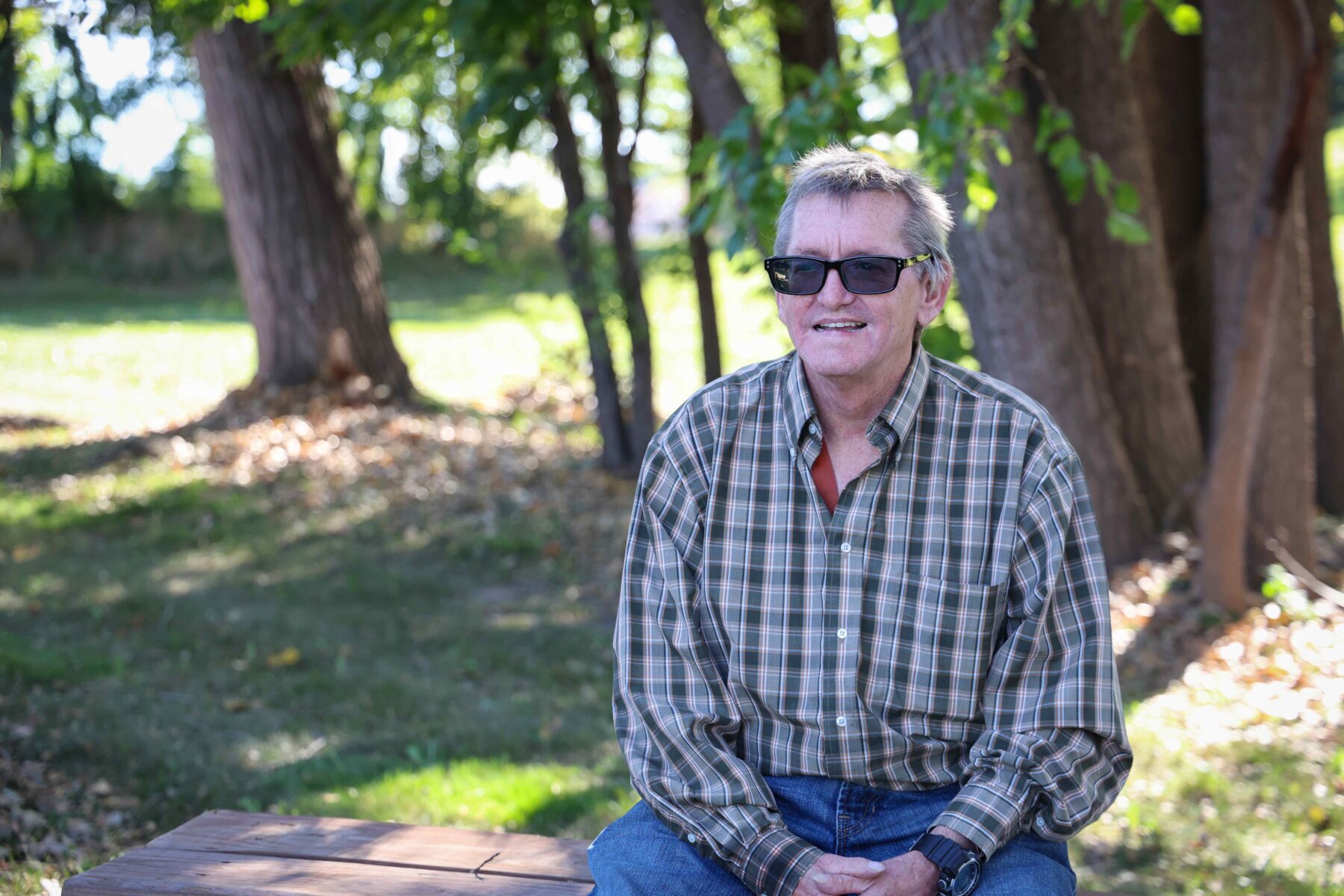
“Before Guild, I didn’t recognize I had a mental illness.”
It’s a phrase we often hear from clients when they first come to Guild in need of mental illness and housing support. Many believe their challenges and struggles are their own fault. That the pain they feel is normal. That they will feel that way for the rest of their lives.
Dan was one of those clients. He’d previously dealt with alcoholism dating back to his military service in the early 1980s but had managed to quit for good when his father was diagnosed with a rare blood disease in 2006. It was around that time, while Dan cared for his ailing father, that he started to notice something else was wrong.
“After I stopped drinking, the mental illness became clearer,” he told us. “My mind began playing games with me. My mother noticed I was struggling.”
Dan’s father ultimately died of the rare blood disease, and that’s when his mental illness truly took hold.
“I was with [my dad] every day,” he said. “We’d spent weekends at the cabin together. Losing him broke something in me.”
In the aftermath of his father’s death, Dan spent several weeks receiving hospitalized in-patient care for his mental health. After he was discharged, he knew he needed to find a place where he could learn more about and understand his mental illness. Guild reached out to Dan and offered support, and he began participating in Guild’s Assertive Community Treatment (ACT) program.
Our ACT program helps individuals struggling with severe and persistent mental illness find hope, healing, and independence. We walk alongside clients to help them establish achievable goals, manage their physical and mental health, and build lifelong skills.
“The ACT team was a lifeline,” Dan said. “They came to my home, helped me with medications, and made sure everything was okay. They supported me with social security paperwork, housing, food, and worked directly with county programs to assist me in everyday life. They helped me stabilize when I couldn’t do it alone. Through talk therapy and the daily structure Guild provided, I was able to heal.”
Dan ultimately found stability and recovery with help from Guild, and he went on to become a volunteer at our Community Support Program (CSP) member center to help other people with mental illness and chemical dependency. He then met Diane, one of our rehabilitation specialists, at our Community Support Program (CSP) member center. “She took me under her wing,” Dan told us.
“Why? Because Guild gave me my life back,” he said. “And now, I get to help others find theirs. We serve coffee and snacks, we have a pantry through Open Door, and we offer a space where people can talk through what they’re going through. We’ve got a music room, a computer lab, a pool table, and even Wii games. But more than that, we’ve got community. There are wellness groups you can join, therapeutic art classes, support groups, morning motion groups to get your body moving, and ‘Lunch With Friends’—a time where members gather to share a meal and conversation. We host different events throughout the year, and we do outings like our dinner club.
“For many of us, this is the only place where we feel truly seen and supported. And for me, it’s a way to stay grounded. I live alone, and coming to CSP every day keeps me from staring at four walls. It keeps me from slipping back into isolation. Most of all, it’s a place to heal, grow, and connect with others.”
Today, Dan thrives off of knowing he’s helping others the same way he once was helped … and he also knows that Guild is still here for him whenever he needs it.
“Guild gave me the tools to rebuild my life. Now, I get to be that person for someone else.”